A Birthday Gift Added to Your Child’s Savings? Check the Plan Before Mixing the Money
A Birthday Gift Added to Your Child’s Savings? Check the Plan Before Mixing the Money
Your child has been saving towards a particular purchase when a birthday card arrives with money inside. They want to put it straight into their money box. Before doing that, take a moment to clarify what the gift is for and how it changes the existing plan.
A larger balance does not automatically mean a larger spending target. A short conversation can help the child understand which money is available for their original goal and what they would like to do with the remainder.
Check whether the gift has a stated purpose
Read the message together. The giver may have intended the money for a particular experience or purchase, or they may have left the decision open.
If the purpose is unclear and matters to the decision, clarify it before assigning the money elsewhere. Avoid telling the child that a gift must go towards their existing savings goal unless that is genuinely part of the arrangement.
When the choice is open, discuss the options within your family’s usual rules. The child might save everything, use part for the current goal or keep some aside while deciding.
Confirm the balance already saved
Before adding the gift, check the existing record. How much has the child collected, and how much remains for the planned purchase?
Do not estimate the balance from the number of visible coins. Different denominations have different values, and a folded note can add considerably to the total without occupying much space.
If a physical count is needed, an adult should open the money box using its intended method and supervise the coins. Resolve any difference between the record and the count before recording the new deposit.
Record only what actually goes into the box
Suppose the gift is KD 5, but the child decides to add KD 3 to the current savings. The deposit recorded for that money box should be KD 3, not the full gift amount.
Give the remaining money an agreed place and purpose. Otherwise, the written balance may include money that has already been spent or is being kept elsewhere.
Keep the record simple: date, amount added and updated balance. A brief note such as “birthday gift contribution” can help explain the entry later without creating an elaborate tracking system.
Revisit the goal without automatically expanding it
The gift may bring the child close to their target or cover the remaining amount entirely. Check the current purchase price before deciding that the goal is complete.
If money will remain afterwards, discuss that separately. There is no need to choose a more expensive item simply because more money is now available.
For a fuller explanation of choosing a first goal, tracking deposits and withdrawals, and selecting a suitable money box, read the K&M Shopping guide:
https://k-m.store/en/teach-children-save-money-box-first-goal
Keep the storage arrangement easy to understand
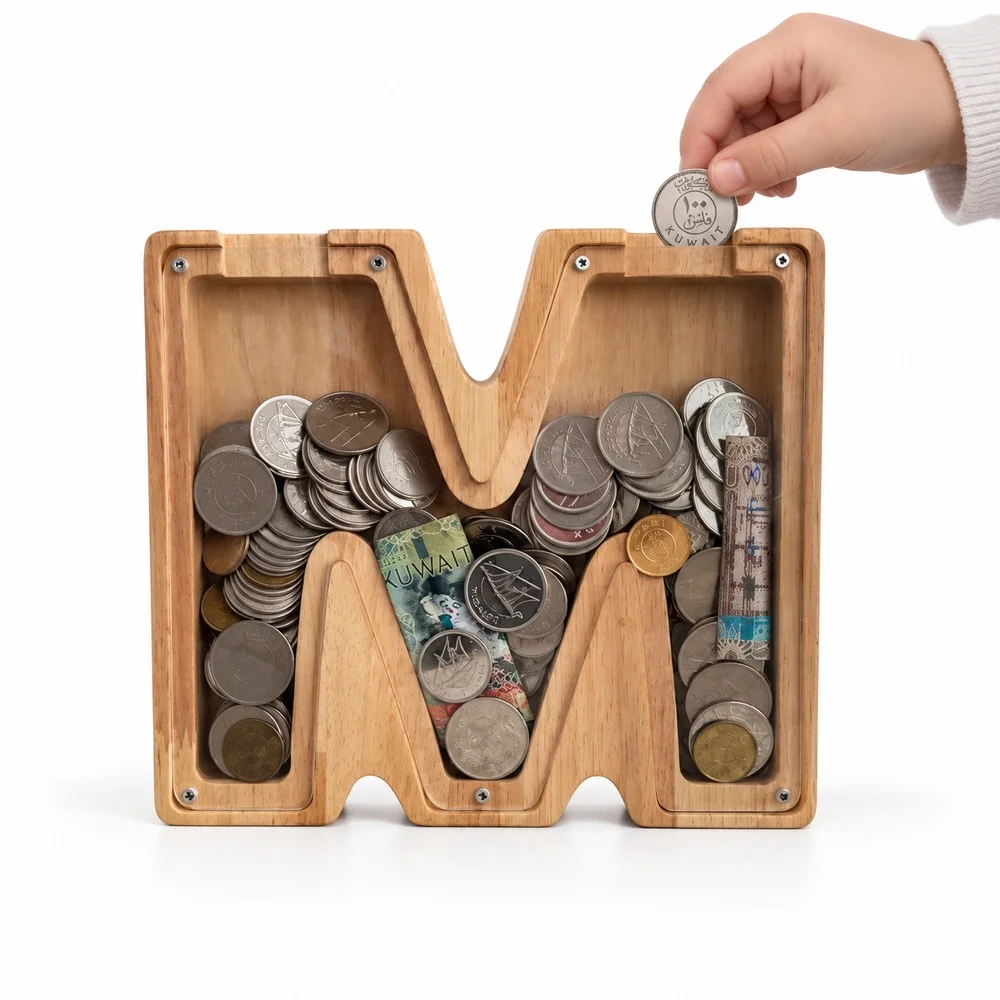
A money box provides a designated place for the amount the child has chosen to save. A transparent front makes the contents visible, while the record explains their value and purpose.
The wooden letter money box from K&M Shopping offers a letter-shaped design with a transparent front. Check the current letter options and product details before choosing:
https://k-m.store/en/wooden-letter-money-box
Insert only coins and appropriately folded notes that fit without force. Keep the box on a stable, dry surface, and keep coins and small parts away from young children who may put them in their mouths.
Finish with one clear next step
Before putting everything away, ask the child to explain the new plan: how much was added, what the money is for and what happens next.
If the target has been reached, the next step may be checking the final price and arranging the purchase. If the child is undecided, keeping the money safely aside while thinking is also a valid choice.
You can browse other products available from K&M Shopping here:
An unexpected gift is an opportunity to practise making a choice. Keep ownership, purpose and the recorded balance clear so that the extra money fits into a plan the child understands.


Comments
Post a Comment